Monday, 21 February 2011

Tuesday, 4 January 2011
Critical questions and issues that emerge
I'm left open minded, I think differently prior to the start of this module because now I know the importance of 'It's not what you know, its who you know', and how powerful this concept is. Positive mental attitude and engagement of sources heightens learning experience. Its not a question of 'doing tasks' its how you perceive the information that surrounds you and use it to develop knowledge that is imperative.
I need to focus my networking skills and aim to move towards more appropriate networks that will develop knowledge within the industry. I have found that the course repeatedly enforces the fact that I need to engage, be inquisitive and motivate my own learning. All sources provided and suggested, point towards the pros of learning via operative use of technology, it's tools and the information available. Learning from more than one source gives a wider range of learning opportunities. My interaction to date should have been better to aid my learning opportunities. A deeper understanding will come from continuous cogitation, contentiousness and reflective skills. My engagement has been at a satisfactory level of appropriateness, this I feel is because my learning has been rather unplanned despite attempts to structure learning time.
Ideas within the 'Inquiry' task seemed to spark discussion and interesting ideas, maybe this is because dance and creativity is the interest in common. Sharing ideas and communicating with others shifted my thinking into a pro-active state developing and progressing with each different opinion. The planning shifted by considering a third, fourth... party and maybe incorporating the ideas that would compliment the outcome. Practice can take on a different form when using constructive criticism or advice, by slightly altering the path in a positive way, via enlightenment.
Critical reflection does help make decisions about what really matters and the actions to take. Through reflection, I could come across a conclusion I wouldn't have considered before. This will facilitate the opportunity to look at all the comprising factors that effect an outcome.
Knowledge is supported through the accumulative theories and concepts across the field. Concepts and theories assist thinking about professional networking in different ways, mainly by amplifying dimensions that may not have been considered before and adding ideas that one could incorporate into practice. Different ways of thinking opens doors to rooms that I wouldn't have previously explored.
I need to focus my networking skills and aim to move towards more appropriate networks that will develop knowledge within the industry. I have found that the course repeatedly enforces the fact that I need to engage, be inquisitive and motivate my own learning. All sources provided and suggested, point towards the pros of learning via operative use of technology, it's tools and the information available. Learning from more than one source gives a wider range of learning opportunities. My interaction to date should have been better to aid my learning opportunities. A deeper understanding will come from continuous cogitation, contentiousness and reflective skills. My engagement has been at a satisfactory level of appropriateness, this I feel is because my learning has been rather unplanned despite attempts to structure learning time.
Ideas within the 'Inquiry' task seemed to spark discussion and interesting ideas, maybe this is because dance and creativity is the interest in common. Sharing ideas and communicating with others shifted my thinking into a pro-active state developing and progressing with each different opinion. The planning shifted by considering a third, fourth... party and maybe incorporating the ideas that would compliment the outcome. Practice can take on a different form when using constructive criticism or advice, by slightly altering the path in a positive way, via enlightenment.
Critical reflection does help make decisions about what really matters and the actions to take. Through reflection, I could come across a conclusion I wouldn't have considered before. This will facilitate the opportunity to look at all the comprising factors that effect an outcome.
Knowledge is supported through the accumulative theories and concepts across the field. Concepts and theories assist thinking about professional networking in different ways, mainly by amplifying dimensions that may not have been considered before and adding ideas that one could incorporate into practice. Different ways of thinking opens doors to rooms that I wouldn't have previously explored.
New Year
Hi Everyone!
Happy New Year! Hope everyone had a great Christmas! Ive had a little time off so ive been able to catch up so this might explain my sudden publishing frenzy! Because of time I haven't commented much on profiles I hope you don't mind if I suddenly comment, I know it's late but better late then never. Anything you wish to discuss would be greatlfully recieved, Thanks guys!
Happy New Year! Hope everyone had a great Christmas! Ive had a little time off so ive been able to catch up so this might explain my sudden publishing frenzy! Because of time I haven't commented much on profiles I hope you don't mind if I suddenly comment, I know it's late but better late then never. Anything you wish to discuss would be greatlfully recieved, Thanks guys!
Task 3c
 Sources of information
An exploration of information-networks investigating methods by which I and others gather information and how external sources are internalised.
My current Sources of information;
- Starnow
- Friends
- Parents
- Employers
Joanna Adeyinka broke down the internet into sub-categories which I think is a great idea as it is such a extensive contrivance full of opportunities. A lot of my information-networks involve the internet. Outlining Google, is something I wouldn't have thought of and using IMDB to research directors etc is also something I could incorporate into my information networks. This may help me discover the professional practice I desire. When I'm honest about my networks it seems that I actually use different networks compared to the available networks that I am aware of or have used in the past.
My information-network internet sub-categories
- Facebook
I use Facebook on a social level as well as a professional level. Dance Cast is available through facebook of which is a professional contact. At the moment this contact could be considered as dormant as I have yet to use them for an audition or employment. I think it would be a good idea to seperate my profile into two like Hayley Jayne Bence. If I established my professional contacts then maybe I could make better use of them. Friends within my Facebook have given me information for auditions through 'chat'.
- Starnow/Dancers Pro
I have a profile on Starnow that probably needs a little care and attention, however I have gained employment from this contact. I took a year in Budapest through Starnow and often receive emails in my Hotmail account alerting me to appropriate castings. This is a great way to gain contacts and information as it allows the employer and potential employees to connect with ease. Dancers Pro works in much the same way. I regularly receive emails for coming auditions and job vacancies that I could be interested in.
Employer
I use Hotmail, text messaging and phone calls to connect with my employer. One employer of mine is a good friend and is more of a partner within the dance school that I teach at. We help each other source information from newspapers, other internet sites and word of mouth to help gain more part time employment.
A company puts on classes for me to teach as a project to get the people in my area active. After a trial where they organise the hire of the room pay for it and my time I am encouraged to keep these classes going on my own. This is a fantastic contact, I have really enjoyed working with them and I have had many opportunities to create business. They often email me with information on courses and other classes in my area.
Parents/Friends
Friends have given me email addresses for casting directors and choreographers. Parents have also talked about classes they want or classes that are available for their children that I could teach. One particular parent at the dancing school got me a job teaching at an after school club at their child's primary school. Maintaining good contact with these people is important as it has proved effective already.
I have found that a lot of these information networks interlink and also cross over into people networks its all connected and maintaining good connections will hopefully help my developing professional persona.
Monday, 3 January 2011
Task 3b
Looking at theories related to networking on the reader and other internet sources, there are so many ideas to reflect upon. Theories that I had not considered before or if I had, had not put such emphasis on pigeon holing them each individually as concepts. These complex concepts are different for each individual as they apply to our own unique networks in various ways.
Cooperation
I know of performers that will squeeze information from others for personal gain and have not reciprocated or have denied knowledge of auditions. This is a world of networks that I feel is negative and is within the field that I am now loosely affiliated with. This is one of the reasons I stopped auditioning, I did not enjoy or like the experience and feel that I would rather have positive networks around me as much as possible. I know that very often it's a 'dog eat dog world', I find myself reeling at the prospect. I saw a piece of art once that I found very poignant, it represented terrorism and the caption was 'An eye for an eye, makes the whole world blind'. Coming from a small close nit family I found comfort in these words. Not everyone is out for themselves. I feel this is how I network. Sometimes maybe I am a little too generous, but I am happy in the knowledge that I did my best for others. Hopefully, if karma exists, one day ill get mine.
The course reader (The Networked Professional 2010, Pg 2) describes cooperation as a theory closely associated with 'Game Theory'. It's origin's lie in the desire to model games where a player succeeds at another expense. Reading further, Axelrod (1984) was one of the most influential researchers in the field and identified this. I found that his TIT FOR TAT theory made a lot of sense. The Prisoner's Dilemma game further enhanced my understanding. Cooperation and a little selfishness did give you a better result. Perhaps a little selfishness won't hurt? I know that this is the natural order of things and that 'It uses an evolutionary perspective because people are often in situations where effective strategies continue to be used and ineffective strategies are dropped.'(The Networked Professional, 2010, pg4)
Affiliation
I agree with this theory and couldn't argue the use of affiliation. Affiliation is the desire and need to 'form close relationships' (Crisp & Turner, 2007 pp266) as a social result of psychological processes operating in our brains and provides us 'with network of support that will help us when we are in need'(Crisp & Turner 2007 pp266). Loneliness is always perceived as a negative feeling and know one I know likes to be alone. We naturally seek friendships and relationships and this is our innate need to network. Whether it be for comfort or love, individuals root for friendship, companionship and professional alliances. I suppose we surround ourselves with these affiliations to help support our needs.
Social Constructionism
According to the Reader this theory describes networks as 'large social constructions.' I agree that ‘existing and future new networks are ‘made’ and the meanings they make are not predetermined.' (The Networked Professional, 2010 pg)
Constructionism 'is the view that all knowledge, and therefore all meaningful reality as such, is contingent upon human practices, being constructed in and out of interaction between human beings and their world, and developed and transmitted within an essentially social context.'
Networking is an individual’s construction for communication and knowledge. We ourselves put emphasis on there value and meaning. Whether a connection is needed or wanted is our own decision. This I understand, however I don't quite agree that 'meaning is not discovered but constructed' (The Networked Professional 2010, pg 7) as this entirely relies on intention. If it is not your intention to keep a contact then their use of you in their network is not constructed by you but discovered.
Heidegger and Merleau Pontys’ 'always already there'(Networked Professional 2010, pg 8), highlights the fact that appropriate networks are out there, I’ve just got to make the right connections to develop my own Professional Practice.
Connectivism
Relates to 'Network Theory' and explains how nodes in a network connect and interact. Learning is described as 'integration of principles explored by chaos, network, and complexity and self organization theories' and that 'knowledge is constructed from the forms and patterns of connections made.(The Networked Professional 2010, pg and 15)
Networking is a part of learning and learning is a developing process within networking.
Siemens, G. (2004) theory that “learning must be a way of being – an ongoing set of attitudes and actions by individuals and groups that they employ to try to keep abreast of the surprising, novel, messy, obtrusive, recurring events…” (1996, p42)
(The Networked Professional 2010, pg 8 and 9)
Gonzalez (2004) describes the challenges of rapidly diminishing knowledge life: “One of the most persuasive factors is the shrinking half life of knowledge", explaining the rate of information becoming 'obsolete', as it is evolving and expanding, far quicker due to technologies and tools available to our generation. Now, we gain information for professional practices that enables us to develop or change career maybe once or twice in a lifetime, compared with 20 years ago when one lifetime profession was normal.
We learn differently in this day and age, I agree with the collective theories and concepts within the reader, instead of learning from one source or one teacher we now learn from communities of practice, personal networks, and through completion of work related tasks. This idea also supports the notion that 'Technology is altering (rewiring) our brains. The tools we use define and shape our thinking.'
Keeping up to date and current with networking tools is the difference between success and failure. Keeping on top of the ever developing and changing technologies will sustain relevance as a practitioner.
Karen Stephenson states: “Experience has long been considered the best teacher of
knowledge. Since we cannot experience everything, other people’s experiences, and
hence other people, become the surrogate for knowledge. ‘I store my knowledge in my
friends’ is an axiom for collecting knowledge through collecting people (undated).”
Staying up to date with networks maintains continuous learning to facilitate my professional practice.
I conclude that the effective use available networks will facilitate learning and will sustain a healthy career. This is a developing process and one that is ongoing. I will be using networks to gain knowledge long after I have finished this course. Identifying value from networks and using them for self betterment will allow my professional practice to prosper. At the moment I'm using networks within the blog system to contribute towards my learning experience, in the future maintaining contacts and finding new networks will continue to advance my knowledge and create career options. I hadn't previously considered the notion that we use networks to gain information, it is now obvious, for example auditions and teaching posts could be found through a friend or professional acquaintance.
Communities of Practice
Lave and Wenger (1991 pp98‐100) 'learning occurs through centripetal participation in the learning curriculum of the ambient community', 'knowledge is within a community of practice'.
A network can be described as a community. From that community of networks knowledge gained is constructive towards our professional practice. Reading further this theory is similar to connectivism as it describes learning as co‐participation. This also supports the idea that taking an active role using technologies as tools to network will further develop my understanding of my professional practice. Furthermore, will continue to do so in the future. I now understand the need for appropriate networks, networking successfully is imperative for developing my knowledge and skills.
References:
The Networked Professional Course Reader, 2010
http://en.wikipedia.org/wiki/The_Evolution_of_Cooperation
Cooperation
I know of performers that will squeeze information from others for personal gain and have not reciprocated or have denied knowledge of auditions. This is a world of networks that I feel is negative and is within the field that I am now loosely affiliated with. This is one of the reasons I stopped auditioning, I did not enjoy or like the experience and feel that I would rather have positive networks around me as much as possible. I know that very often it's a 'dog eat dog world', I find myself reeling at the prospect. I saw a piece of art once that I found very poignant, it represented terrorism and the caption was 'An eye for an eye, makes the whole world blind'. Coming from a small close nit family I found comfort in these words. Not everyone is out for themselves. I feel this is how I network. Sometimes maybe I am a little too generous, but I am happy in the knowledge that I did my best for others. Hopefully, if karma exists, one day ill get mine.
The course reader (The Networked Professional 2010, Pg 2) describes cooperation as a theory closely associated with 'Game Theory'. It's origin's lie in the desire to model games where a player succeeds at another expense. Reading further, Axelrod (1984) was one of the most influential researchers in the field and identified this. I found that his TIT FOR TAT theory made a lot of sense. The Prisoner's Dilemma game further enhanced my understanding. Cooperation and a little selfishness did give you a better result. Perhaps a little selfishness won't hurt? I know that this is the natural order of things and that 'It uses an evolutionary perspective because people are often in situations where effective strategies continue to be used and ineffective strategies are dropped.'(The Networked Professional, 2010, pg4)
Affiliation
I agree with this theory and couldn't argue the use of affiliation. Affiliation is the desire and need to 'form close relationships' (Crisp & Turner, 2007 pp266) as a social result of psychological processes operating in our brains and provides us 'with network of support that will help us when we are in need'(Crisp & Turner 2007 pp266). Loneliness is always perceived as a negative feeling and know one I know likes to be alone. We naturally seek friendships and relationships and this is our innate need to network. Whether it be for comfort or love, individuals root for friendship, companionship and professional alliances. I suppose we surround ourselves with these affiliations to help support our needs.
Social Constructionism
According to the Reader this theory describes networks as 'large social constructions.' I agree that ‘existing and future new networks are ‘made’ and the meanings they make are not predetermined.' (The Networked Professional, 2010 pg)
Constructionism 'is the view that all knowledge, and therefore all meaningful reality as such, is contingent upon human practices, being constructed in and out of interaction between human beings and their world, and developed and transmitted within an essentially social context.'
Networking is an individual’s construction for communication and knowledge. We ourselves put emphasis on there value and meaning. Whether a connection is needed or wanted is our own decision. This I understand, however I don't quite agree that 'meaning is not discovered but constructed' (The Networked Professional 2010, pg 7) as this entirely relies on intention. If it is not your intention to keep a contact then their use of you in their network is not constructed by you but discovered.
Heidegger and Merleau Pontys’ 'always already there'(Networked Professional 2010, pg 8), highlights the fact that appropriate networks are out there, I’ve just got to make the right connections to develop my own Professional Practice.
Connectivism
Relates to 'Network Theory' and explains how nodes in a network connect and interact. Learning is described as 'integration of principles explored by chaos, network, and complexity and self organization theories' and that 'knowledge is constructed from the forms and patterns of connections made.(The Networked Professional 2010, pg and 15)
Networking is a part of learning and learning is a developing process within networking.
Siemens, G. (2004) theory that “learning must be a way of being – an ongoing set of attitudes and actions by individuals and groups that they employ to try to keep abreast of the surprising, novel, messy, obtrusive, recurring events…” (1996, p42)
(The Networked Professional 2010, pg 8 and 9)
Gonzalez (2004) describes the challenges of rapidly diminishing knowledge life: “One of the most persuasive factors is the shrinking half life of knowledge", explaining the rate of information becoming 'obsolete', as it is evolving and expanding, far quicker due to technologies and tools available to our generation. Now, we gain information for professional practices that enables us to develop or change career maybe once or twice in a lifetime, compared with 20 years ago when one lifetime profession was normal.
We learn differently in this day and age, I agree with the collective theories and concepts within the reader, instead of learning from one source or one teacher we now learn from communities of practice, personal networks, and through completion of work related tasks. This idea also supports the notion that 'Technology is altering (rewiring) our brains. The tools we use define and shape our thinking.'
Keeping up to date and current with networking tools is the difference between success and failure. Keeping on top of the ever developing and changing technologies will sustain relevance as a practitioner.
Karen Stephenson states: “Experience has long been considered the best teacher of
knowledge. Since we cannot experience everything, other people’s experiences, and
hence other people, become the surrogate for knowledge. ‘I store my knowledge in my
friends’ is an axiom for collecting knowledge through collecting people (undated).”
Staying up to date with networks maintains continuous learning to facilitate my professional practice.
I conclude that the effective use available networks will facilitate learning and will sustain a healthy career. This is a developing process and one that is ongoing. I will be using networks to gain knowledge long after I have finished this course. Identifying value from networks and using them for self betterment will allow my professional practice to prosper. At the moment I'm using networks within the blog system to contribute towards my learning experience, in the future maintaining contacts and finding new networks will continue to advance my knowledge and create career options. I hadn't previously considered the notion that we use networks to gain information, it is now obvious, for example auditions and teaching posts could be found through a friend or professional acquaintance.
Communities of Practice
Lave and Wenger (1991 pp98‐100) 'learning occurs through centripetal participation in the learning curriculum of the ambient community', 'knowledge is within a community of practice'.
A network can be described as a community. From that community of networks knowledge gained is constructive towards our professional practice. Reading further this theory is similar to connectivism as it describes learning as co‐participation. This also supports the idea that taking an active role using technologies as tools to network will further develop my understanding of my professional practice. Furthermore, will continue to do so in the future. I now understand the need for appropriate networks, networking successfully is imperative for developing my knowledge and skills.
References:
The Networked Professional Course Reader, 2010
http://en.wikipedia.org/wiki/The_Evolution_of_Cooperation
Tuesday, 28 December 2010
Task 3a Current Networks
Looking inward at how I engage with my current networks and using the campus session I became aware of the fact that I only engage with Networks 'Seasonally'. By this I mean I use them at times when work in a particular area is not fulfilling my needs as a professional. To have a really successful network I feel I need to put more effort into all contacts to secure the knowledge that I am available and capable of work. Therefore improving and developing my current networks.
Technology is the most convenient and effective way to keep connected. Conversely, It is still important to remember that social networking is also very effective. Word of mouth can be very powerful and I found when my classes started that most people had heard about the class through a friend or through someone that had participated before. As technology is progressing it is getting easier to rely on them, becoming lazy when it comes to connecting with people, particularly clients is something I am guilty of. When someone adds a personal touch or makes a special effort it is usually appreciated or reciprocated. I have to find a way to connect with potential clients in a way that reaches them on a personal level. Something to think about.
Our generation relies on technology for networking, it is ever increasing and will always be developing. Now that word of mouth doesn't reach so far and technology is growing it is getting easier to reach more people at a quicker rate. Advertising, through emails, posters, letters and leaflets.
I have a number of contacts including those I use through and with employers. A company sources clubs and PE Sessions in my area for me to coach. I teach for them everyday and we engage via email, phone calls and text messages. Text messages are the most effective way of contact when working, as I can not access emails or phone calls when driving or teaching. I can simply read a message when convenient. If I had a smart phone (with easy internet access) This would be a lot more effective, I could access my email account as well as phones messages.
There are many tools, nodes and methods in which I personally network, many of which discussed in my Campus Session Blog previous. The tool I feel I favor most is my phone. This I use to engage with all my employers and clients.
I have a dongle (USB Broadband) that allows me access to the internet when I am mobile but it is not always convenient to have a laptop on my person. This is a great tool that I use frequently when at home or at a friends house to get on with some much needed correspondence.
Various factors influence the capacity of nodes to form connections. Once a network has been established, the flow of information can move from one domain to another with relative ease. The stronger the connection between nodes, the more rapidly information will flow. (Seimens 2005) (http://www.astd.org/LC/2005/1105_seimens.htm)
I frequently use mobile phones and the internet, one node of which actively affects my day to day networking is email. I give, share and receive emails from colleagues, Friends, Employers and Agencies on a regular bases this keeps me connected and helps me organise my work.
Another node which is very important to me is Facebook. I use this social networking site to source clients from friends for dance classes. I use my status to advertise classes and use conversations on chat to get friends talking. I regularly receive emails from Dance Cast via Facebook, although I have yet to use this casting agency. This is because I am not in a 'season' that requires further development in this area of my professional practice. I have tried Linkedin I think if I had the time I could put a little more effort into usng this site to make meaningful positive professional connections.
I have friends that have contacts on various cruise ships. Once upon a time this was a career that I had thought I wanted to take up. Now, I admire the way in which my friends have networks that include at least a few performers/dance captains and choreographers on different contracts. Using their networking skills and these friendships, friends have managed to get new contracts traveling aboard better Cruise Liners.
This is apparent on Facebook. Using this social networking site to keep up with friends, little effort is needed to maintain these friendships. This applies to my own current networking skills and will help develop and maintain useful friendships. As Laura Jane Wier said it is important to make sure these friends do not feel used when you need them, I completely agree. Maintaining a caring attitude and using good social skills will keep these friendships ripe. After all, they probably have the same intentions as you. Once the affiliation has been made it if often the case that people want to help each other.
My ideal network would probably be in the educational field, people more qualified and experienced then I, that could help or advise me along the way. A larger network of successful professionals might actually help me decide on a career path. I think a pocket of friends in many fields of the industry would have great benefits. Agents, Directors, Producers, Teachers past and present, people still training and friends at the same level as I would all be people I would be interested in networking with.
Realistically, to improve my networks I need to spend more time to make connections with friends. At parties and get togethers I could actually network a little better and meet more people in the same industry, then keeping friendships and nurturing them using sites such as Facebook online.
I do not know enough about social networking online. If I'm honest other than Facebook, I like to stay away from new and unknown sites like Linkedin and Twitter, as I feel that I don't have enough time to put into them. I need to find time and I need to explore the wide spectrum of internet networking sites available to me.
From this I repeatedly see excuses that involve time. Maybe the actual fault at play here is organisation of time. I have found that I struggle to prioritise work and lack the motivation to correct this. New Year, New Resolutions, time to motivate, prioritise and organise my Professional Practice!
References:
'Connectivism: Learning as Network-Creation' By George Siemens
(http://www.astd.org/LC/2005/1105_seimens.htm)
Technology is the most convenient and effective way to keep connected. Conversely, It is still important to remember that social networking is also very effective. Word of mouth can be very powerful and I found when my classes started that most people had heard about the class through a friend or through someone that had participated before. As technology is progressing it is getting easier to rely on them, becoming lazy when it comes to connecting with people, particularly clients is something I am guilty of. When someone adds a personal touch or makes a special effort it is usually appreciated or reciprocated. I have to find a way to connect with potential clients in a way that reaches them on a personal level. Something to think about.
Our generation relies on technology for networking, it is ever increasing and will always be developing. Now that word of mouth doesn't reach so far and technology is growing it is getting easier to reach more people at a quicker rate. Advertising, through emails, posters, letters and leaflets.
I have a number of contacts including those I use through and with employers. A company sources clubs and PE Sessions in my area for me to coach. I teach for them everyday and we engage via email, phone calls and text messages. Text messages are the most effective way of contact when working, as I can not access emails or phone calls when driving or teaching. I can simply read a message when convenient. If I had a smart phone (with easy internet access) This would be a lot more effective, I could access my email account as well as phones messages.
There are many tools, nodes and methods in which I personally network, many of which discussed in my Campus Session Blog previous. The tool I feel I favor most is my phone. This I use to engage with all my employers and clients.
I have a dongle (USB Broadband) that allows me access to the internet when I am mobile but it is not always convenient to have a laptop on my person. This is a great tool that I use frequently when at home or at a friends house to get on with some much needed correspondence.
Various factors influence the capacity of nodes to form connections. Once a network has been established, the flow of information can move from one domain to another with relative ease. The stronger the connection between nodes, the more rapidly information will flow. (Seimens 2005) (http://www.astd.org/LC/2005/1105_seimens.htm)
I frequently use mobile phones and the internet, one node of which actively affects my day to day networking is email. I give, share and receive emails from colleagues, Friends, Employers and Agencies on a regular bases this keeps me connected and helps me organise my work.
Another node which is very important to me is Facebook. I use this social networking site to source clients from friends for dance classes. I use my status to advertise classes and use conversations on chat to get friends talking. I regularly receive emails from Dance Cast via Facebook, although I have yet to use this casting agency. This is because I am not in a 'season' that requires further development in this area of my professional practice. I have tried Linkedin I think if I had the time I could put a little more effort into usng this site to make meaningful positive professional connections.
I have friends that have contacts on various cruise ships. Once upon a time this was a career that I had thought I wanted to take up. Now, I admire the way in which my friends have networks that include at least a few performers/dance captains and choreographers on different contracts. Using their networking skills and these friendships, friends have managed to get new contracts traveling aboard better Cruise Liners.
This is apparent on Facebook. Using this social networking site to keep up with friends, little effort is needed to maintain these friendships. This applies to my own current networking skills and will help develop and maintain useful friendships. As Laura Jane Wier said it is important to make sure these friends do not feel used when you need them, I completely agree. Maintaining a caring attitude and using good social skills will keep these friendships ripe. After all, they probably have the same intentions as you. Once the affiliation has been made it if often the case that people want to help each other.
My ideal network would probably be in the educational field, people more qualified and experienced then I, that could help or advise me along the way. A larger network of successful professionals might actually help me decide on a career path. I think a pocket of friends in many fields of the industry would have great benefits. Agents, Directors, Producers, Teachers past and present, people still training and friends at the same level as I would all be people I would be interested in networking with.
Realistically, to improve my networks I need to spend more time to make connections with friends. At parties and get togethers I could actually network a little better and meet more people in the same industry, then keeping friendships and nurturing them using sites such as Facebook online.
I do not know enough about social networking online. If I'm honest other than Facebook, I like to stay away from new and unknown sites like Linkedin and Twitter, as I feel that I don't have enough time to put into them. I need to find time and I need to explore the wide spectrum of internet networking sites available to me.
From this I repeatedly see excuses that involve time. Maybe the actual fault at play here is organisation of time. I have found that I struggle to prioritise work and lack the motivation to correct this. New Year, New Resolutions, time to motivate, prioritise and organise my Professional Practice!
References:
'Connectivism: Learning as Network-Creation' By George Siemens
(http://www.astd.org/LC/2005/1105_seimens.htm)
Wednesday, 22 December 2010
Task 2d Inquiry
Where to start?
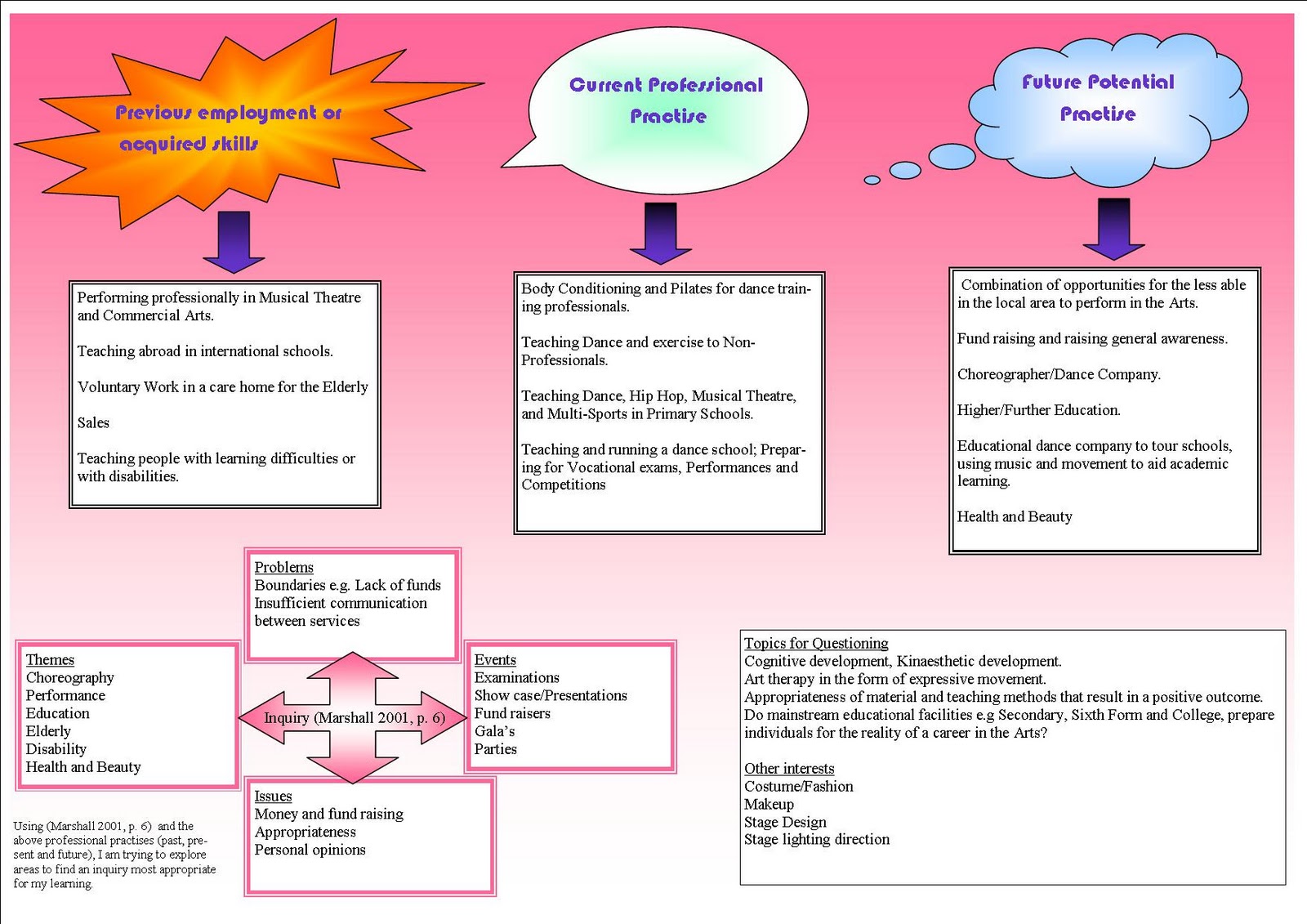
I wasn't sure where to start or what angle to go with. I suppose if im honest I am enthusiastic about choreography and performance. I love to create shapes that have a narrative or meaning. Dances that provoke thought or emotion to music that equally compliments the importance of the story, I find extremely rewarding.
I would like to find out more about the inspirations behind other choreographers particularly those in the field of contemporary dance. I like the idea of combining genres to create something different. When choreographing I try to think outside the box and I like to use subjects that express a proverb.
I love that I can use the dancing school I teach at as a blank canvass to create interesting pieces of performing art. In some classes in particular I can really explore difficult choreography as the students are at a standard of technique and flexibility equivalent to professionals.
I admire my dance teachers before me that created such interesting pieces. More so at the dancing school then at college. I found the teachers I had had something very special, I was lucky to learn from such professionals as they were working professionals themselves and still are.
I am really enthusiastic about combining styles of dance within a dance piece. Using music that you wouldn’t necessarily associate with certain dance styles I find really interesting and if you get it right quite beautiful. Using material to create shapes and work with I feel adds another dimension.
Money and lack of organisation frustrates me, I wish I could have a PA, not many people have this privilege and it’s something I could really benefit from. I am determined to improve admin and communication skills, by soldiering through everything I tackle asking as many questions as possible to those who support me. I am sad that I don’t have a bigger number of dancers to work with more often. For this I need money or funding to support wages etc. To alleviate my angst about limited funds, I choreograph for advanced students at the dancing school, this allows me to explore ideas and release some creative energy.
I admire choreographers that work with nothing that can dance and not worry about money and bills. Those who have nothing, but work so hard no matter what the outcome I envy the most. They have no interest in earning a living and strive for that one goal. I wish I had this motivation and faith. I have always backed myself up with employment and qualifications, I know this is very sensible of me. Maybe I need to be a little bit mad to be an innovator or choreographic genius. To win big time you have to gamble everything you’ve got, at present for me it is not practical to take this route, I aspire to learn and grow. One day, hopefully I can create something of my own that I can be proud of.
'What subject would create an interesting, thought provoking choreographical piece, combining different dance and music styles to portray something poignant?'
I wasn't sure where to start or what angle to go with. I suppose if im honest I am enthusiastic about choreography and performance. I love to create shapes that have a narrative or meaning. Dances that provoke thought or emotion to music that equally compliments the importance of the story, I find extremely rewarding.
I would like to find out more about the inspirations behind other choreographers particularly those in the field of contemporary dance. I like the idea of combining genres to create something different. When choreographing I try to think outside the box and I like to use subjects that express a proverb.
I love that I can use the dancing school I teach at as a blank canvass to create interesting pieces of performing art. In some classes in particular I can really explore difficult choreography as the students are at a standard of technique and flexibility equivalent to professionals.
I admire my dance teachers before me that created such interesting pieces. More so at the dancing school then at college. I found the teachers I had had something very special, I was lucky to learn from such professionals as they were working professionals themselves and still are.
I am really enthusiastic about combining styles of dance within a dance piece. Using music that you wouldn’t necessarily associate with certain dance styles I find really interesting and if you get it right quite beautiful. Using material to create shapes and work with I feel adds another dimension.
Money and lack of organisation frustrates me, I wish I could have a PA, not many people have this privilege and it’s something I could really benefit from. I am determined to improve admin and communication skills, by soldiering through everything I tackle asking as many questions as possible to those who support me. I am sad that I don’t have a bigger number of dancers to work with more often. For this I need money or funding to support wages etc. To alleviate my angst about limited funds, I choreograph for advanced students at the dancing school, this allows me to explore ideas and release some creative energy.
I admire choreographers that work with nothing that can dance and not worry about money and bills. Those who have nothing, but work so hard no matter what the outcome I envy the most. They have no interest in earning a living and strive for that one goal. I wish I had this motivation and faith. I have always backed myself up with employment and qualifications, I know this is very sensible of me. Maybe I need to be a little bit mad to be an innovator or choreographic genius. To win big time you have to gamble everything you’ve got, at present for me it is not practical to take this route, I aspire to learn and grow. One day, hopefully I can create something of my own that I can be proud of.
'What subject would create an interesting, thought provoking choreographical piece, combining different dance and music styles to portray something poignant?'
Subscribe to:
Posts (Atom)